















Medical weight loss
Orforglipron: what the clinical evidence tells us about this oral weight-management medicine
Medical information from the Effect Doctors clinical team
For many years, medicines used for medical weight management have mainly been given by injection. Orforglipron is a newer type of medicine: an oral, once-daily small-molecule GLP-1 receptor agonist.
This article summarises what is currently known about orforglipron, including the clinical trial evidence, how it works, potential side effects and some of the limitations of the available evidence.
Orforglipron is a prescription-only medicine. Whether any prescription medicine is appropriate depends on an individual’s medical history, circumstances, treatment goals and an assessment by an appropriately qualified healthcare professional.
How does Orforglipron work?
Appetite and food intake are regulated by complex signals between the digestive system and the brain. One of the hormones involved is glucagon-like peptide-1, commonly known as GLP-1.
GLP-1 receptors are found in several parts of the body, including areas involved in appetite regulation. Activation of these receptors can reduce appetite and food intake and can also slow the movement of food through the stomach.
Orforglipron is a GLP-1 receptor agonist. Unlike peptide GLP-1 receptor agonists, it is a small-molecule compound that can be taken orally.
This is an important pharmaceutical distinction. Some other oral medicines in this area are peptide-based and have specific requirements concerning how and when they are taken. Orforglipron is designed as a small molecule and can be taken once daily, with or without food.
The effect on appetite varies between individuals. The aim of treatment is not simply to reduce a number on the scales, but to support clinically appropriate weight management as part of a broader programme that can include nutrition, physical activity and behavioural support.
What does the research show?
The principal Phase 3 trial of orforglipron in adults with obesity or overweight without diabetes was the ATTAIN-1 study, published in the New England Journal of Medicine.
The trial included 3,127 adults with an average body weight of approximately 103 kg and an average BMI of approximately 37 kg/m². Participants received one of three doses of orforglipron or placebo for 72 weeks. All participants also received lifestyle counselling, including advice relating to diet and physical activity.
Among participants who adhered to treatment, the highest-dose group experienced an average reduction in body weight of approximately 12.4% at 72 weeks, compared with approximately 0.9% with placebo.
More than half of participants receiving the highest dose achieved at least 10% weight loss, while more than one third achieved at least 15% weight loss.
The study also reported improvements in several cardiometabolic measures, including systolic blood pressure and triglyceride concentrations.
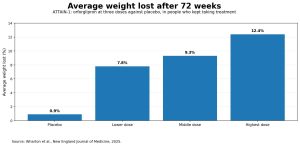
Figure 1. ATTAIN-1 average weight loss at 72 weeks. Source: Wharton et al., New England Journal of Medicine, 2025. These are trial averages and are not a prediction of an individual’s response.
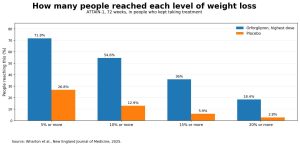
Figure 2. ATTAIN-1: proportion of participants reaching specified weight-loss thresholds at 72 weeks among participants who remained on treatment. Source: Wharton et al., New England Journal of Medicine, 2025.
How does orforglipron compare with injectable weight-management medicines?
It is tempting to compare the results of different weight-management medicines directly, but this needs to be done cautiously.
Different clinical trials use different populations, treatment doses, study designs, follow-up periods and definitions of outcomes. Consequently, results from separate trials cannot reliably establish that one medicine produces greater weight loss than another.
There is currently no head-to-head trial establishing how orforglipron compares directly with each of the established injectable GLP-1-based or related treatments.
For that reason, treatment decisions should be based on the individual’s circumstances rather than on a comparison of headline percentages from separate studies.
What are the side effects of orforglipron?
The most commonly reported adverse effects are gastrointestinal. These include nausea, diarrhoea, vomiting and constipation.
These effects are particularly common when treatment is started or when the dose is increased. They are generally mild to moderate, although some people experience symptoms that are more troublesome.
In ATTAIN-1, approximately 10% of participants receiving the highest dose discontinued treatment because of adverse events, compared with approximately 3% receiving placebo.
As with any prescription medicine, the potential benefits need to be considered alongside the potential risks for the individual.
The current UK prescribing information should be consulted for the complete list of warnings, precautions, interactions and adverse effects.
Who can take orforglipron?
Orforglipron is licensed for specific adults requiring medical weight management, subject to the criteria in the UK product information.
It is not appropriate for everyone.
A clinician will need to consider factors including body weight and BMI, existing medical conditions, previous or current weight-management treatment, other medicines being taken, pregnancy or plans for pregnancy, breastfeeding, previous adverse reactions to medicines, and relevant medical and family history.
Some medicines may interact with orforglipron, and the medicine can affect the absorption of some orally administered medicines because of its effects on gastrointestinal function.
There are also specific considerations for people taking oral contraception. The UK prescribing information contains specific advice concerning additional or alternative contraception during treatment initiation and after dose escalation.
For these reasons, orforglipron should only be started following an appropriate medical assessment and in accordance with the current UK prescribing information.
Weight loss is not the same as fat loss
An important consideration with any substantial weight reduction is body composition.
When people lose weight, the reduction is not exclusively body fat. Some lean tissue is normally lost as well. Studies of incretin-based weight-management medicines have found that lean mass can account for a significant proportion of total weight lost, although the precise proportion varies between individuals and studies.
This does not mean that treatment is harmful to muscle or that weight loss should be avoided. Weight reduction can have substantial benefits for health and physical function, particularly when clinically appropriate.
It does, however, highlight the importance of considering what makes up the weight being lost, rather than focusing solely on the number on the scales.
Adequate protein intake, resistance exercise and appropriate physical activity can all be important components of preserving physical function and lean tissue during weight loss. In some circumstances, monitoring body composition can provide additional information alongside weight, waist circumference and other clinical measures.
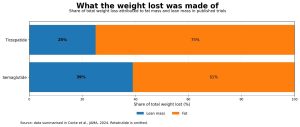
Figure 3. Published body-composition data for tirzepatide and semaglutide. Source: data summarised in Conte et al., JAMA, 2024. Retatrutide is omitted from this version.
Medical weight management is about more than medication
Medication is only one possible component of a medical weight-management programme.
An appropriate approach starts with an assessment of the individual’s health, weight history, lifestyle, existing conditions and medicines. Depending on the circumstances, this may include blood tests or other investigations.
The purpose of the assessment is to establish whether medical weight management is appropriate and, where medication is being considered, whether the potential benefits and risks justify treatment.
Treatment can then be reviewed over time. This is particularly important when a medicine is being started or a dose is being increased, because tolerability, response, nutrition, physical activity and other aspects of health may need to be reassessed.
There is no single weight-management medicine that is suitable for everyone. The appropriate approach depends on the individual clinical circumstances.
Medical weight management at Effect Doctors
At Effect Doctors, medical weight management begins with a consultation rather than with the selection of a particular medicine.
A doctor takes a medical history, reviews current medicines and considers relevant health factors. Where appropriate, investigations such as blood tests can be arranged.
If prescription treatment is considered appropriate, the available options can then be discussed with the patient, including their potential benefits, risks, practical considerations and suitability.
Follow-up allows treatment to be reviewed over time, including response, tolerability, nutrition, physical activity and, where appropriate, body composition.
The aim is to provide medical oversight throughout the process rather than treating medication as a standalone solution.
Weight-management consultations are available at Effect Doctors’ clinics in Soho and Westfield London, as well as through our London home-visit service.
The evidence will continue to develop
Orforglipron is a relatively new medicine and the evidence base will continue to develop as it is used more widely and further studies report their findings.
Clinical trials provide important evidence about average outcomes and risks, but they do not predict exactly how an individual will respond. Longer-term evidence will also help clarify outcomes beyond the periods studied in the initial clinical trials.
For anyone considering prescription treatment for weight management, the most appropriate starting point is an individual medical assessment rather than choosing a particular medicine based on a headline trial result.
References
1. Wharton S, et al. Orforglipron, an Oral Small-Molecule GLP-1 Receptor Agonist in Adults with Obesity. New England Journal of Medicine. 2025.
2. Foundayo (orforglipron) UK Summary of Product Characteristics. Electronic Medicines Compendium.
3. Secher A, et al. The arcuate nucleus mediates GLP-1 receptor agonist-induced weight loss. Journal of Clinical Investigation. 2014;124:4473–4488.
4. Conte C, et al. Body composition changes with incretin-based obesity medications. JAMA. 2024;332:9–10.
5. Hunter Gibble T, et al. Tirzepatide and health-related quality of life in adults with obesity or overweight. Diabetes, Obesity and Metabolism. 2025.
Recent effect insights

Medical weight loss
Five Essential Things I Wish Patients Knew Before Starting Tirzepatide (Mounjaro)
Many people come to us excited about starting Mounjaro (tirzepatide). The headlines are impressive, and for many, it feels like the first real breakthrough after years of struggling with weight, appetite, insulin resistance or metabolic issues. But patients often tell us the same thing in hindsight: “I wish I had known these things at the […]...
December 3, 2025
Medical weight loss
What to Eat While Taking Mounjaro
Starting Mounjaro is a powerful step in your weight loss journey. What you eat alongside it makes all the difference. Dr Will Turner shar...
August 22, 2025

Medical weight loss
Seven Myths about Weight Loss Drugs Mounjaro and Wegovy.
Mounjaro and Wegovy have transformed the way we approach weight loss—but these medications work best with the right support. In this ar...
May 30, 2025