














IV drips
CoQ10 Benefits: The Essential Molecule That Helps Power Your Body
Have you ever wondered why some people seem to have endless energy while others feel constantly tired, despite eating well and getting enough sleep?
The answer isn’t always straightforward. Fatigue can have many causes, from poor sleep and stress to nutritional deficiencies and underlying medical conditions. But one fascinating molecule has attracted increasing attention from doctors and researchers because of the vital role it plays in how every cell in the body produces energy.
That molecule is Coenzyme Q10, more commonly known as CoQ10.
Unlike many supplements that come and go with wellness trends, CoQ10 isn’t something foreign to your body. It’s something your body naturally produces and relies on every single day. Every heartbeat, every breath, every thought and every movement depends on it.
At Effect Doctors, we’re increasingly asked about CoQ10—particularly by people interested in improving energy levels, supporting healthy ageing or optimising their overall wellbeing. So, what exactly is it, what are the benefits of CoQ10, and could it be something worth considering?
Reviewed & Published by:
Dr William Buxton
Dr William Buxton

Dr William Buxton
Dr Buxton is an Consultant Anaesthetist and a fellow of the Royal College of Anaesthetists; he is a founding member of Effect Doctors.
Read BiographyWhat is CoQ10?
CoQ10 is a naturally occurring compound found in almost every cell of the human body.
Its primary role is to help produce adenosine triphosphate (ATP)—the molecule that stores and delivers energy to your cells.
Think of your body as a city.
Every building needs electricity to function. In your body, ATP is that electricity, and CoQ10 is one of the key components that helps generate it.
This happens inside tiny structures called mitochondria, often referred to as the “powerhouses” of the cell.
Without enough CoQ10, your cells can still generate energy, but not as efficiently.
This is particularly important in organs that work continuously throughout your life, including:
- Your heart
- Your brain
- Your muscles
- Your kidneys
- Your liver
These tissues contain the highest concentrations of mitochondria because they require enormous amounts of energy every day.
CoQ10 is more than just an energy molecule
While CoQ10 is best known for energy production, it has another equally important role.
It acts as a powerful antioxidant.
Every day our cells produce free radicals as a natural by-product of metabolism. Pollution, UV light, smoking, stress and illness can all increase this oxidative stress.
Over time, oxidative stress can damage cells and contribute to ageing and chronic disease.
CoQ10 helps neutralise these free radicals, protecting cell membranes, proteins and DNA from damage.
This combination of supporting energy production while helping defend cells is why CoQ10 has become one of the most researched nutritional compounds in longevity medicine.
What are the benefits of CoQ10?
When people search for “CoQ10 benefits”, they’re usually hoping for a simple answer.
The reality is slightly more nuanced.
CoQ10 isn’t a stimulant and it isn’t a miracle cure.
Instead, it supports one of the body’s most fundamental biological processes—how your cells create energy.
Research suggests CoQ10 may support:
Natural energy production
Because CoQ10 is essential for ATP production, it has been studied extensively in relation to energy and fatigue.
Many people who supplement with CoQ10 don’t describe a sudden boost in energy like drinking coffee.
Instead, they often report:
- feeling more consistently energised throughout the day
- less mentally fatigued
- better able to cope with busy schedules
- fewer afternoon energy crashes
- improved resilience
This gradual improvement makes biological sense. Rather than stimulating the nervous system, CoQ10 supports your body’s own energy-producing machinery.
Heart health
Your heart beats around 100,000 times every day.
Not surprisingly, it requires enormous amounts of energy.
The heart contains some of the highest concentrations of CoQ10 anywhere in the body.
Researchers have investigated CoQ10 for decades in relation to cardiovascular health, particularly in people with heart failure and those taking statin medications.
While CoQ10 should never replace prescribed medication, studies suggest it may support healthy cardiac function alongside standard medical care.
Healthy ageing
One reason CoQ10 has become popular in longevity medicine is that natural production declines with age.
By our forties and fifties, levels may be significantly lower than they were in early adulthood.
Researchers believe this decline may contribute to some of the changes associated with ageing, including reduced cellular energy production.
Although ageing is influenced by many different factors, maintaining healthy mitochondrial function is increasingly recognised as an important part of healthy ageing.
Exercise and recovery
Every time you exercise, your muscles dramatically increase their energy requirements.
CoQ10 has been studied in athletes and recreational exercisers because of its potential role in improving mitochondrial efficiency and reducing oxidative stress.
While it isn’t a performance-enhancing drug, some studies suggest it may support recovery following intense exercise.
Brain health
The brain represents only around 2% of your body weight but consumes approximately 20% of your daily energy.
Researchers have investigated whether supporting mitochondrial function with CoQ10 may play a role in maintaining cognitive health and neurological function.
Although research continues, this remains an exciting area of ongoing study.
Why do CoQ10 levels decline?
One of the fascinating aspects of CoQ10 is that your body manufactures it naturally.
Unfortunately, production gradually decreases with age.
Lower levels may also occur in people who:
- take statin medications
- have certain cardiovascular conditions
- have mitochondrial disorders
- experience chronic illness
- are exposed to prolonged physical or emotional stress
This doesn’t necessarily mean everyone should supplement, but it helps explain why CoQ10 has become increasingly popular among middle-aged adults and those interested in preventative healthcare.
Can you get enough CoQ10 from food?
Yes—but probably not therapeutic amounts.
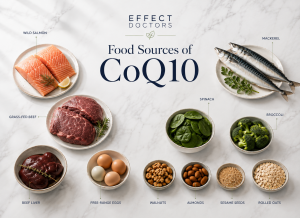
Foods naturally containing CoQ10 include:
- Sardines
- Mackerel
- Salmon
- Beef
- Chicken
- Liver
- Peanuts
- Sesame seeds
- Broccoli
- Spinach
A balanced diet remains the foundation of good health.
However, the quantities found in food are relatively small compared with the doses used in many research studies.
Oral supplements versus injectable CoQ10
Most people are familiar with CoQ10 capsules.
However, CoQ10 is a fat-soluble molecule, which means absorption through the digestive system can be inconsistent.
This is one reason injectable forms have become increasingly popular in medical wellness clinics.
Oral CoQ10
Capsules are convenient and suitable for long-term daily supplementation.
Absorption is improved when taken with a meal containing healthy fats.
Intramuscular (IM) CoQ10
At Effect Doctors, we offer IM CoQ10 as a quick injection administered by one of our clinicians.
Because it bypasses the digestive system, it avoids many of the absorption challenges associated with oral supplements.
Treatment takes only a few minutes and may suit individuals looking for convenient mitochondrial support.
Intravenous (IV) CoQ10
For patients receiving a Bespoke IV Drip, CoQ10 can also be incorporated into an individually prescribed treatment plan.
Delivering nutrients directly into the bloodstream allows rapid systemic availability and enables our clinicians to combine CoQ10 with other carefully selected ingredients where clinically appropriate.
Whether IM or IV is most suitable depends on your medical history, treatment goals and clinical assessment.
Who might consider CoQ10?
CoQ10 may be worth discussing with a healthcare professional if you:
- feel persistently low in energy
- are interested in healthy ageing
- are taking statin medication
- exercise regularly and want to support recovery
- are looking to optimise overall wellbeing
Persistent fatigue should always be properly investigated first.
Iron deficiency, thyroid disorders, vitamin deficiencies, poor sleep and many medical conditions can produce similar symptoms.
This is why we often recommend appropriate Blood Tests & Health Screening before considering nutritional therapies.
Is CoQ10 safe?
CoQ10 has an excellent safety profile and is generally well tolerated.
Occasionally people experience:
- mild digestive upset
- headache
- dizziness
- nausea
People taking blood-thinning medications such as warfarin should always discuss CoQ10 with their doctor before starting supplementation.
At Effect Doctors, all injectable treatments are preceded by a medical assessment to ensure they are appropriate for each individual.
The bigger picture
No supplement or injection replaces the foundations of good health.
Quality sleep, regular exercise, balanced nutrition, hydration and stress management remain the cornerstones of maintaining healthy energy levels.
CoQ10 should be viewed as one component of a broader approach to wellbeing rather than a standalone solution.
Our philosophy has always been to understand why someone isn’t feeling their best before recommending any treatment. That may involve blood testing, a medical consultation or a personalised treatment plan that addresses the underlying cause rather than simply masking symptoms.
Frequently Asked Questions
What are the main benefits of CoQ10?
CoQ10 supports the body’s natural production of cellular energy and acts as a powerful antioxidant. Research suggests it may support healthy energy levels, cardiovascular health, exercise recovery and healthy ageing.
Does CoQ10 help with fatigue?
CoQ10 may help some people whose fatigue is related to reduced mitochondrial function or low CoQ10 levels. However, fatigue has many potential causes, so persistent symptoms should always be medically assessed.
Is injectable CoQ10 better than capsules?
Injectable CoQ10 bypasses the digestive system and provides more predictable absorption than oral supplements. Whether this translates into better clinical outcomes depends on the individual and the reason for treatment.
Who should consider CoQ10?
People interested in supporting healthy ageing, maintaining energy levels, exercising regularly or taking statin medication may wish to discuss CoQ10 with a healthcare professional.
Does Effect Doctors offer CoQ10?
Yes. Following a clinical assessment, Effect Doctors offers both Intramuscular (IM) CoQ10 injections and IV CoQ10 within personalised Bespoke IV Drips where clinically appropriate.
Disclaimer: This article is intended for educational purposes only and should not be considered medical advice. If you have persistent fatigue, cardiovascular disease or are taking prescription medication, seek advice from a qualified healthcare professional before starting any new supplement or injectable therapy.
Recent effect insights

IV drips
ADHD, Nutrition and Micronutrients: What We Know About Iron, Zinc, Vitamin D and Magnesium
Attention deficit hyperactivity disorder (ADHD) is a neurodevelopmental condition. It is not caused by a ...
October 8, 2026

Iron infusions
IV drips
Choosing the right ingredient for your Iron Infusion
Why We Use Ferric Derisomaltose for All Our Iron Infusions
Iron deficiency is one of the most common nutritional deficiencies worl...
June 8, 2026

IV drips
Metabolic Breath Tests
Cortisol Explained: The Truth About Stress, Belly Fat, Sleep and Energy
If you’ve spent any time on social media recently, you’ve probably seen someone blaming cortisol for ...
June 8, 2026