












Hyperbaric Oxygen Therapy (HBOT)
Hyperbaric Oxygen Therapy: What It Does, Where It Works and What the Evidence Says
A pulse oximeter tells you how much oxygen your blood is carrying. It does not tell you everything about how oxygen is reaching your tissues. Understanding the difference helps explain what hyperbaric oxygen therapy does — and where the evidence is strong, emerging or still uncertain.
Reviewed & Published by:
Dr William Turner
Dr William Turner

Dr William Turner
Dr Turner is a Consultant Anaesthetist and a fellow of the Royal College of Anaesthetists; he is a founding member of Effect Doctors.
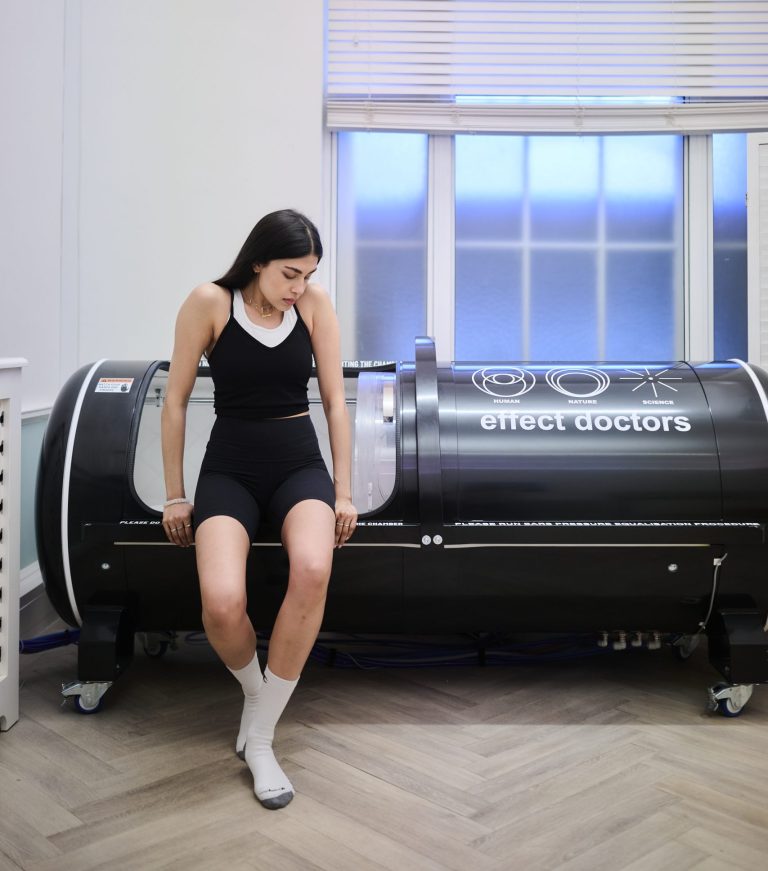
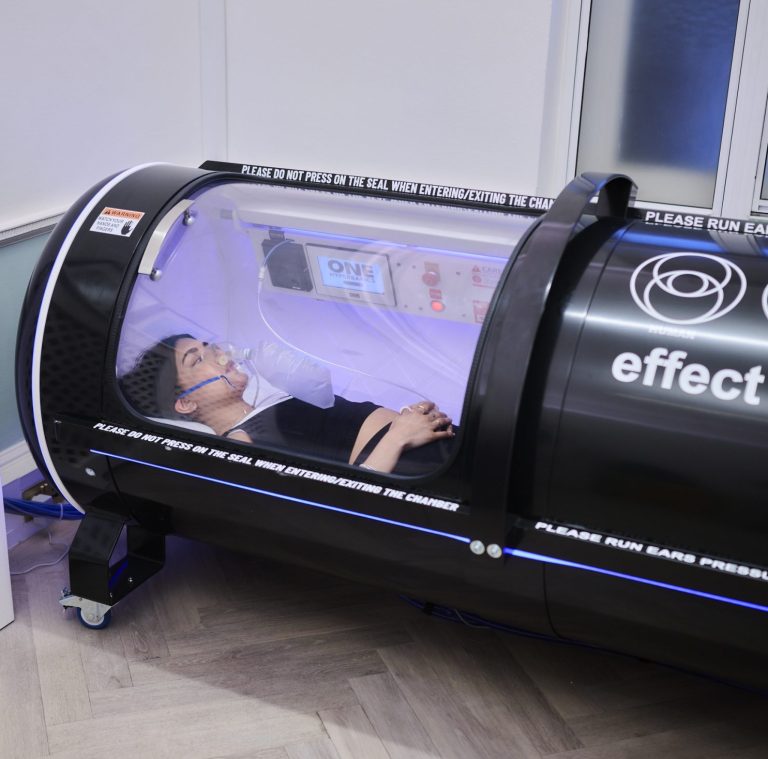
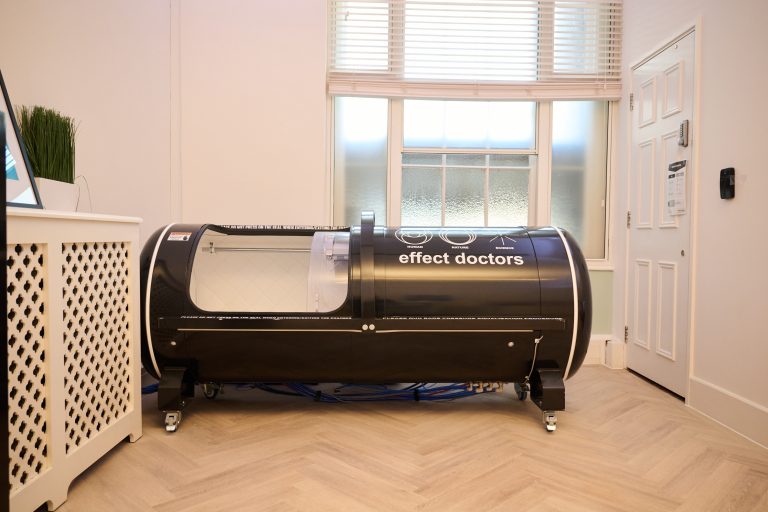
Read BiographyThe hyperbaric chamber at our Soho clinic
Put a pulse oximeter on your finger and you will hopefully read 96 to 99 per cent. In an anaesthetic room, I would be content with that number. It tells me that your haemoglobin is highly saturated with oxygen and, in broad terms, that your heart and lungs are doing their job.
What it does not tell me is how much oxygen is reaching a particular piece of tissue.
Saturation is a measure of the carrier, not the delivery.
That distinction is central to understanding hyperbaric oxygen therapy (HBOT). It is also why HBOT is an established hospital treatment for a defined group of clinical conditions.
The physiology is genuinely interesting, but it is important to separate what we know from what we think might be possible. That is the approach we take at Effect Doctors.
The physics of the ceiling
Almost all the oxygen in your arterial blood is bound to haemoglobin. A small fraction — around one to two per cent — is dissolved directly in the plasma.
Haemoglobin has a practical ceiling. Once it is saturated, it cannot carry substantially more oxygen, no matter how deeply you breathe or how much supplemental oxygen you receive at normal atmospheric pressure.
The dissolved fraction behaves differently. It follows Henry’s law, meaning that the amount of oxygen dissolved in plasma rises in proportion to the partial pressure of oxygen. Unlike haemoglobin, it does not have the same saturation ceiling.
The limitation is that, at normal atmospheric pressure, the dissolved amount is very small.
Put someone in a hyperbaric chamber at two atmospheres while breathing oxygen through a mask and arterial oxygen tension can rise dramatically — to around 1,000 mmHg, compared with roughly 100 mmHg when breathing air at sea level.
The dissolved fraction rises with it. In practical terms, something that is normally a very small component of oxygen transport becomes much more significant.
What makes this clinically interesting is not simply the headline oxygen number. It is the gradient.
Oxygen moves from the capillaries into surrounding tissue by diffusion. The greater the pressure difference driving that movement, the further oxygen can travel from each capillary.
This is one of the mechanisms thought to matter particularly in tissue where oxygen delivery is compromised by factors such as inflammation, oedema or poor perfusion.
That is the physiological basis for HBOT. Whether that physiology translates into a meaningful clinical benefit depends on the condition being treated and, importantly, on the quality of the evidence.
Where the evidence is strongest
Hyperbaric oxygen is an established hospital treatment for a defined group of clinical indications. These include:
- Decompression illness and arterial gas embolism
- Carbon monoxide poisoning
- Severe and necrotising soft tissue infection and gangrene
- Osteoradionecrosis and soft tissue radiation injury
- Diabetic foot ulceration
- Sudden sensorineural hearing loss, as an adjunct alongside urgent ENT care
- Compromised skin grafts and flaps
- Refractory bone infection
The precise indications and circumstances in which HBOT is appropriate vary between conditions.
In wound healing, for example, the underlying mechanism is relatively well characterised. Sustained hyperoxia can influence vascular endothelial growth factor and other pathways involved in tissue repair and the formation of new capillary networks.
The important point is that HBOT is generally an adjunct to appropriate underlying medical or surgical treatment. It is not a replacement for it.
Where we treat patients with established clinical indications, we work alongside their existing care and, where appropriate, their treating clinician.
Why else do people take HBOT
A much wider range of people seek HBOT for recovery, wellbeing and performance. This is where it is particularly important to be honest about the evidence.
People come to us for:
- Recovery following facelift, rhinoplasty and oculoplastic surgery, with the agreement of their surgeon
- Post-operative soft tissue healing more generally
- Soft tissue recovery following strenuous training or competition
- General recovery and energy levels during periods of high physical or work demand
- Mental clarity and concentration
- Sleep quality
- Travel recovery and jet lag following long-haul flights
- Skin quality and collagen support alongside aesthetic treatment
- Endurance and training adaptation in athletes
- Joint and soft tissue comfort following repetitive load
- Recovery of stamina following a period of illness
- Supporting resilience during demanding periods
A lot of what people come to us for sits in territory where the literature has not yet provided a definitive answer.
Our position is straightforward.
Where a course is safe and appropriate for you, where there is a genuine signal in the published evidence, and where you understand what is and is not known, we will support your decision and, where practical, measure whether it is doing anything useful.
We do not believe in promising an outcome simply because a plausible mechanism exists.
Concussion and persistent post-concussion symptoms
This is an active area of research, with genuinely mixed results.
Some randomised studies have reported improvements following HBOT, including differences in cognitive measures and symptom burden. Other well-designed military trials have found no significant difference compared with sham treatment.
That is a real split in the evidence.
For that reason, we do not present HBOT as an established treatment for persistent post-concussion symptoms. If someone is considering a course in this setting, we explain the uncertainty, agree what improvement would look like and, where possible, track outcomes rather than assuming that treatment has worked.
Persistent symptoms after viral illness
There is also emerging evidence for HBOT in people with persistent symptoms following viral illness, including post-COVID condition.
A 2022 randomised controlled trial reported improvements in neurocognitive function and symptom burden.
That is encouraging, but it is one trial and does not provide a basis for promising an outcome to every patient.
If you are considering HBOT in this setting, we will screen you medically, discuss what the evidence can and cannot tell us, agree what improvement would look like at the outset and review the result honestly afterwards.
Recovery after surgery and hard training
The strongest surgical evidence is in tissue that is genuinely struggling — for example, a compromised graft or flap where perfusion is threatened.
For people recovering normally from surgery, the evidence is less definitive. The post-operative literature is encouraging in some areas, while studies looking at muscle soreness and recovery following strenuous exercise have produced mixed results.
We therefore approach these uses on that basis. We will tell you where the evidence stands rather than implying that HBOT will automatically accelerate recovery.
We do not simply work from lists of conditions supplied by chamber manufacturers. We look at the published literature and, where the evidence is thin, we say so.
Pressure is a dose
We use a hard-shell chamber pressurised with air, with oxygen delivered through a non-rebreather mask, at pressures of up to 2.0 ATA.
The pressure used during a session is not simply a matter of turning the machine up to its maximum.
Different conditions and protocols use different pressures. The evidence for a number of established indications sits within approximately the 1.5 to 2.0 ATA range, while some research protocols — particularly in neurological conditions — have used lower pressures.
More is not automatically better.
The pressure we use is therefore a clinical decision. We prescribe it, record it and adjust the treatment according to the individual and the indication. For most people, that does not mean simply using the maximum pressure available.
Risks, because there are some
Properly prescribed and properly screened, HBOT is generally a safe treatment. It is not risk-free, and you should be wary of anyone who tells you otherwise.
The most common problems relate to pressure: ear and sinus barotrauma. These can usually be managed with appropriate equalisation techniques, similar to those used when flying.
Other possible effects include temporary short-sightedness during a longer course, which generally resolves, and anxiety or discomfort associated with being inside the chamber.
Oxygen toxicity seizures are thankfully very rare at the pressures and treatment durations we use.
There is also a potential fire risk in oxygen-rich environments, which is why chamber configuration and safety procedures matter.
Some clinics operate chambers filled with pure oxygen. Ours is pressurised with air, with oxygen delivered through a mask. This is the configuration used in many hospital hyperbaric units and provides a different safety profile from a chamber filled with oxygen.
We nevertheless take the precautions required in any pressurised oxygen environment.
Patients wear appropriate clinic cotton clothing and are asked not to use cosmetics, oils, certain dressings or vapes before treatment. Oxygen levels inside the chamber are continuously monitored.
These precautions are routine, deliberate and non-negotiable.
Who should not have HBOT?
Untreated pneumothorax is an absolute contraindication. Severe peripheral bullous lung disease, certain chemotherapy agents including bleomycin, and a number of other conditions or circumstances also require particular consideration.
Recent ear surgery, poorly controlled epilepsy, significant air-trapping lung disease and untreated fever all need medical assessment before treatment.
Everyone is screened by a doctor or specialist nurse before their first session.
Why anaesthetists run this
Managing oxygen delivery in people under pressure is our day job.
Effect Doctors was founded and is run by consultant anaesthetists. Our HBOT protocols are doctor-designed and prescribed, patients are medically screened, and the chamber operates under written clinical governance as part of our CQC registration.
The chamber itself is only one part of the treatment.
The important decisions are who should go into it, why they are having treatment, at what pressure and for how long, and whether the treatment is actually helping.
That is where medical experience matters.
What happens before your first session?
We start with you rather than the chamber.
Before treatment, we assess your medical history, discuss what you are hoping to achieve and check for any conditions or medications that could make HBOT unsuitable.
If treatment is appropriate, we explain what to expect, agree the treatment parameters and make sure you understand both the potential benefits and the limitations of the evidence.
During the session, you remain under clinical supervision.
If you are undertaking a course for a specific purpose, we can also agree in advance what improvement would look like and review your response rather than simply assuming that more sessions must mean more benefit.
Adding IV therapy
We will sometimes pair a course of HBOT with intravenous micronutrients.
The principle is straightforward: if your blood tests identify a deficiency, correcting that deficiency is worthwhile in its own right. Doing so alongside another treatment may also be convenient.
We do not claim that combining IV therapy with HBOT automatically produces a greater effect than either intervention alone.
Where there is a clinical reason to correct a deficiency, we treat it on its own merits.
If you are considering HBOT
Raising arterial oxygen tension under pressure produces real and measurable changes in oxygen delivery.
For a defined group of clinical conditions, that translates into a treatment with an established role.
For a much wider group of uses, the physiology is promising and the evidence is still developing.
We think you deserve to know the difference.
At Effect Doctors, our approach is to explain what is established, what is emerging and what remains uncertain — then decide with you whether HBOT is appropriate.
If you would like to know whether hyperbaric oxygen therapy might be appropriate for you, speak to one of our doctors on 020 7305 7608.
Find out more and book here.
References
- Boerema I, Meyne NG, Brummelkamp WK, et al. Life without blood. J Cardiovasc Surg. 1960;1:133-146.
- Thom SR. Hyperbaric oxygen: its mechanisms and efficacy. Plast Reconstr Surg. 2011;127(Suppl 1):131S-141S. doi:10.1097/PRS.0b013e3181fbe2bf
- Huang ET, ed. Undersea and Hyperbaric Medical Society Hyperbaric Medicine Indications Manual. 15th ed. North Palm Beach, FL: Best Publishing Company; 2023.
- Walker WC, Franke LM, Cifu DX, Hart BB. Randomized, sham-controlled, feasibility trial of hyperbaric oxygen for service members with postconcussion syndrome: cognitive and psychomotor outcomes 1 week postintervention. Neurorehabil Neural Repair. 2014;28(5):420-432. doi:10.1177/1545968313516869
- Cifu DX, Hart BB, West SL, Walker W, Carne W. The effect of hyperbaric oxygen on persistent postconcussion symptoms. J Head Trauma Rehabil. 2014;29(1):11-20. doi:10.1097/HTR.0b013e3182a6aaf8
- Cifu DX, Walker WC, West SL, et al. Hyperbaric oxygen for blast-related postconcussion syndrome: three-month outcomes. Ann Neurol. 2014;75(2):277-286. doi:10.1002/ana.24067
- Miller RS, Weaver LK, Bahraini N, et al; HOPPS Trial Team. Effects of hyperbaric oxygen on symptoms and quality of life among service members with persistent postconcussion symptoms: a randomized clinical trial. JAMA Intern Med. 2015;175(1):43-52. doi:10.1001/jamainternmed.2014.5479
- Weaver LK, Wilson SH, Lindblad AS, et al. Hyperbaric oxygen for post-concussive symptoms in United States military service members: a randomized clinical trial. Undersea Hyperb Med. 2018;45(2):129-156.
- Weaver LK, Churchill S, Wilson SH, Hebert D, Deru K, Lindblad AS. A composite outcome for mild traumatic brain injury in trials of hyperbaric oxygen. Undersea Hyperb Med. 2019;46(3):341-352.
- Boussi-Gross R, Golan H, Fishlev G, et al. Hyperbaric oxygen therapy can improve post concussion syndrome years after mild traumatic brain injury: randomized prospective trial. PLoS One. 2013;8(11). doi:10.1371/journal.pone.0079995
- Hadanny A, Catalogna M, Yaniv S, et al. Hyperbaric oxygen therapy in children with post-concussion syndrome improves cognitive and behavioral function: a randomized controlled trial. Sci Rep. 2022;12:15233.
- Crawford C, Teo L, Yang E, Isbister C, Berry K. Is hyperbaric oxygen therapy effective for traumatic brain injury? A rapid evidence assessment of the literature and recommendations for the field. J Neurotrauma. 2023;40:1592-1613.
- Zilberman-Itskovich S, Catalogna M, Sasson E, et al. Hyperbaric oxygen therapy improves neurocognitive functions and symptoms of post-COVID condition: randomized controlled trial. Sci Rep. 2022;12:11252. doi:10.1038/s41598-022-15565-0
Recent effect insights
Hyperbaric Oxygen Therapy (HBOT)
IV drips
How Hyperbaric Oxygen Therapy Enhances the Benefits of IV Infusions
Dr Will Buxton discusses how combining hyperbaric oxygen therapy alongside an IV drip infusion enhances the impact of both.
...
October 23, 2025
Hyperbaric Oxygen Therapy (HBOT)
The Science-Backed Power of Hyperbaric Oxygen Therapy
The science is there: Hyperbaric Oxygen Therapy is backed by decades of clinical use and scientific study showing significa...
August 21, 2025
Hyperbaric Oxygen Therapy (HBOT)
The Benefits of Hyperbaric Oxygen Therapy
Hyperbaric Oxygen Therapy (HBOT) has been gaining recognition for its impressive range of health benefits. Originally used to treat decompression sickness in divers, HBOT now serves as a therapeutic option for various medical conditions. With an increasing number of advocates for the treatment and growing demand from our clients, here’s an in-depth look at the […]...
January 17, 2025