












Iron infusions
Postpartum Iron Deficiency: Why New Mothers Are Often Iron Deficient After Birth
Having a baby is one of the most demanding physiological experiences the body goes through. Pregnancy places substantial demands on iron stores, and childbirth can involve further blood loss.
For some women, the result is postpartum iron deficiency, which is sometimes accompanied by anaemia, but not always.
The symptoms can be easy to dismiss as simply being part of life with a newborn: profound tiredness, reduced concentration, weakness, headaches, dizziness, breathlessness or feeling that you are struggling to recover physically after pregnancy and birth, but iron deficiency can be an important and treatable contributor.
At Effect Doctors, we increasingly see women who have continued to feel depleted weeks or months after giving birth and who discover that their iron stores have not recovered. In appropriate patients, intravenous iron can replace iron more rapidly when oral iron is unsuitable, poorly tolerated, or insufficient.
Reviewed & Published by:
Dr William Buxton
Dr William Buxton

Dr William Buxton
Dr Buxton is an Consultant Anaesthetist and a fellow of the Royal College of Anaesthetists; he is a founding member of Effect Doctors.
Read BiographyPregnancy and childbirth can significantly deplete iron stores
Iron requirements rise substantially during pregnancy. Iron is needed to support the expansion of maternal blood volume and the developing placenta and fetus, and the situation can become more pronounced when there is significant blood loss during delivery.
It’s crucial therefore not to expect postpartum anaemia to simply be a problem for the first few days after delivery. For some women, depleted iron stores can persist well beyond the immediate postnatal period – the World Health Organisation notes that iron stores can remain low for several months after childbirth, particularly when there has been significant blood loss during delivery and insufficient iron replacement.
Iron deficiency is not the same as anaemia
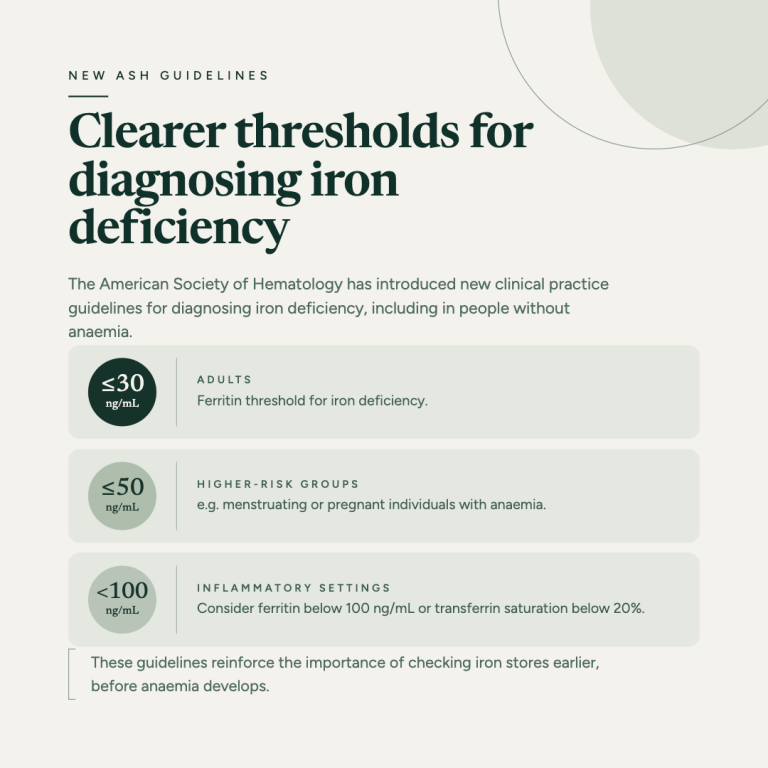
This distinction is important – anaemia means that the haemoglobin level is below the appropriate reference range, whereas iron deficiency means that the body’s available iron stores are inadequate. The two often occur together, but they are not synonymous. Patients are said to be anaemic with an HB <115g/L. If you are pregnant, due to changes which occur in pregnancy, that figure lowers to <100g/L. Up to 50% of pregnant women are iron deficient, and modern guidelines advise that women who are pregnant maintain their Ferritin at least above 50ug/L and diagnose iron deficiency below that level.
A woman can have a haemoglobin level that has returned to the normal range while still having depleted iron stores, and this is one reason that looking only at haemoglobin may not tell the whole story.
Ferritin is commonly used as a marker of iron stores, although it needs to be interpreted in clinical context; the level can rise in response to inflammation and infection.
For a woman who remains unusually tired after childbirth, a proper assessment may therefore include a full blood count alongside iron studies rather than simply asking whether her haemoglobin is “normal”. Anyone with a Ferritin under 30 ug/L has severe iron deficiency; though in the presence of systemic inflammation, usually demonstrated by an elevated CRP (inflammation falsely pushes up the Ferritin), that figure rises to <100 ug/L. Usually in these cases, TSAT (another blood test) is <20%.
What does postpartum iron deficiency feel like?
The symptoms can overlap considerably with normal postpartum experiences.
A new mother may experience:
- persistent or overwhelming fatigue
- reduced physical stamina
- weakness
- headaches
- dizziness or light-headedness
- shortness of breath, particularly with exertion
- poor concentration or difficulty thinking clearly
- reduced ability to exercise
- palpitations
- feeling generally depleted or unable to recover
This can create a difficult situation. Sleep deprivation, caring for a newborn, hormonal changes and the physical recovery from pregnancy and childbirth can all produce fatigue, but that does not mean persistent fatigue should automatically be attributed to having a new baby. Iron deficiency and anaemia are among the potentially treatable causes that deserve consideration, and research has linked postpartum anaemia with a poorer health-related quality of life, emphasising fatigue and symptoms of depression.
Why postpartum blood loss matters
Blood loss during childbirth is one of the most obvious reasons iron stores can fall. Even when a woman does not require a blood transfusion, significant blood loss can leave her with substantially depleted iron reserves; this is particularly relevant because replacing haemoglobin and replacing iron stores are not necessarily the same thing.
The body needs iron to produce new red blood cells and restore its reserves. If iron replacement is inadequate, a woman may continue to feel unwell while the underlying deficiency persists.
The World Health Organisation’s postpartum guidance recognises iron supplementation as part of postnatal care, and their recent recommendations on postpartum haemorrhage include intravenous iron when rapid correction is needed, after significant blood loss or when oral iron has not been effective.
Oral iron is often the first step
Oral iron remains an important treatment for iron deficiency and iron-deficiency anaemia, and for some it works very well. However, oral iron can also cause gastrointestinal side effects such as nausea, abdominal discomfort, constipation or diarrhoea. Many women therefore find it difficult to take consistently, particularly during the already demanding postpartum period. There are also situations where oral iron may not provide the desired response quickly enough (or at all) or may not be appropriate, and this is where intravenous iron can have a role.
What is an iron infusion?
An intravenous iron infusion delivers iron directly into a vein, and so unlike oral iron, it does not depend on absorption through the gastrointestinal tract. Where in the past multiple infusions were required, modern intravenous iron preparations are often able to restore a person’s iron levels in a single infusion. The precise dose and treatment plan should be determined following clinical assessment and appropriate blood testing. Understand more about our iron infusions at Effect Doctors.
When might an iron infusion be considered after pregnancy?
There is no single treatment that is right for every woman. The Royal College of Obstetricians and Gynaecologists recommends considering IV iron when a woman has a documented iron deficiency or iron deficiency anaemia, and oral iron isn’t appropriate – this could include:
- oral iron has not produced an adequate response
- oral iron causes significant side effects
- oral iron cannot be tolerated
- there has been significant blood loss during childbirth
- rapid restoration of iron is clinically appropriate
- there is a need to replenish substantial iron stores
- the clinician considers intravenous treatment more appropriate based on the individual circumstances
Importantly, an infusion is not simply a treatment for feeling tired. The decision should follow appropriate clinical assessment and blood results.
What does the evidence tell us?
Evidence specifically examining intravenous iron after childbirth shows its efficacy in replenishing iron stores faster than oral treatment – a systematic review and meta-analysis of randomised trials involving more than 4,000 women with postpartum anaemia found that intravenous iron was associated with greater improvements in haemoglobin and ferritin and subsequent reduction in fatigue when compared to oral iron. However, the evidence emphasises that intravenous iron is not appropriate in every case, and so clinical assessment and interpretation are key.
The important message is not that intravenous iron should replace oral iron. It is that intravenous iron is an established treatment option for appropriately selected women who need iron replacement.
Can you have an iron infusion while breastfeeding?
Understandably this is an important question for many – available evidence for both Monofer (ferric derisomaltose) and Ferrinject (ferric carboxymaltose) is reassuring, showing that at therapeutic doses iron infusions are safe and only minimal amounts of iron are transferred into the breastmilk. Iron deficiency anaemia can also increase the likelihood of breastfeeding difficulties, further emphasising the importance of restoring your iron levels following birth.
Nevertheless, breastfeeding status should always be discussed with the clinician before treatment, and the choice of preparation should be based on the individual patient.
Can you have an iron infusion while pregnant?
Yes though not in the first three months of pregnancy except in exceptional circumstances.
The risks and benefits for both mother and child must be carefully considered.
How we approach postpartum iron deficiency at Effect Doctors
At Effect Doctors, we believe that treating iron deficiency should start with understanding the patient’s clinical picture and blood results – rather than assuming that postpartum fatigue is simply part of having a newborn, we can assess whether iron deficiency may be contributing.
Depending on the circumstances, assessment may include:
Full blood count
To assess haemoglobin and red blood cell indices.
Ferritin and iron studies
To assess iron stores and iron availability.
Clinical assessment
To understand symptoms, pregnancy history, delivery, blood loss, previous iron treatment and other potential causes of fatigue.
Where iron deficiency is confirmed and intravenous replacement is clinically appropriate, our doctors can discuss whether an iron infusion is suitable; the aim is not simply to increase a laboratory number, it is to identify the underlying deficiency and provide an appropriate, evidence-based treatment plan.
Don’t assume that feeling exhausted is just part of being a new mother
The postpartum period is demanding, and tiredness is expected, but persistent or disproportionate fatigue deserves consideration, particularly following a pregnancy complicated by iron deficiency or significant blood loss during delivery.
If you continue to feel depleted after childbirth, checking your iron status can be a straightforward way of investigating whether iron deficiency is part of the picture. For some women oral iron is sufficient, but for others intravenous iron may offer a more practical or effective way of restoring depleted iron stores.
At Effect Doctors, our doctors can assess your symptoms and blood results and advise whether an iron infusion is appropriate for you.
Recent effect insights
Iron infusions
Iron Deficiency Without Anaemia: Why New ASH Guidelines Reflect the Approach We Take at Effect Doctors
The American Society of Hematology has introduced new standards for diagnosing iron deficiency. At Effect Doctors, the underlying prin...
September 24, 2026

Iron infusions
IV drips
Choosing the right ingredient for your Iron Infusion
Why We Use Ferric Derisomaltose for All Our Iron Infusions
Iron deficiency is one of the most common nutritional deficiencies worl...
June 8, 2026

Iron infusions
Why “Optimum” Is Not the Same as “Normal” When Measuring Iron Levels in Women
Iron is a critical mineral for overall health, particularly for women who experience menstruation, pregnancy, or other factors that can d...
February 17, 2025